
This Help topic refers to the following editions:
þ Enterprise þProfessional þ Personal þSmall Business
From the DocuXplorer Desktop Ribbon Tab select Home | Options | Microsoft
The  symbol next to a property group indicates that settings are applied globally
to all users. If the symbol is absent, settings apply only to the currently
logged-in user.
symbol next to a property group indicates that settings are applied globally
to all users. If the symbol is absent, settings apply only to the currently
logged-in user.
Only administrators have the authority to modify these properties.
Microsoft settings bridge the gap between standardized product behavior and individual user requirements. These configurations manage key functional areas, including Azure AI Process Engine, Document Intelligence, Storage Accounts, MS Office Integration, MS Office Events, and MS Outlook.
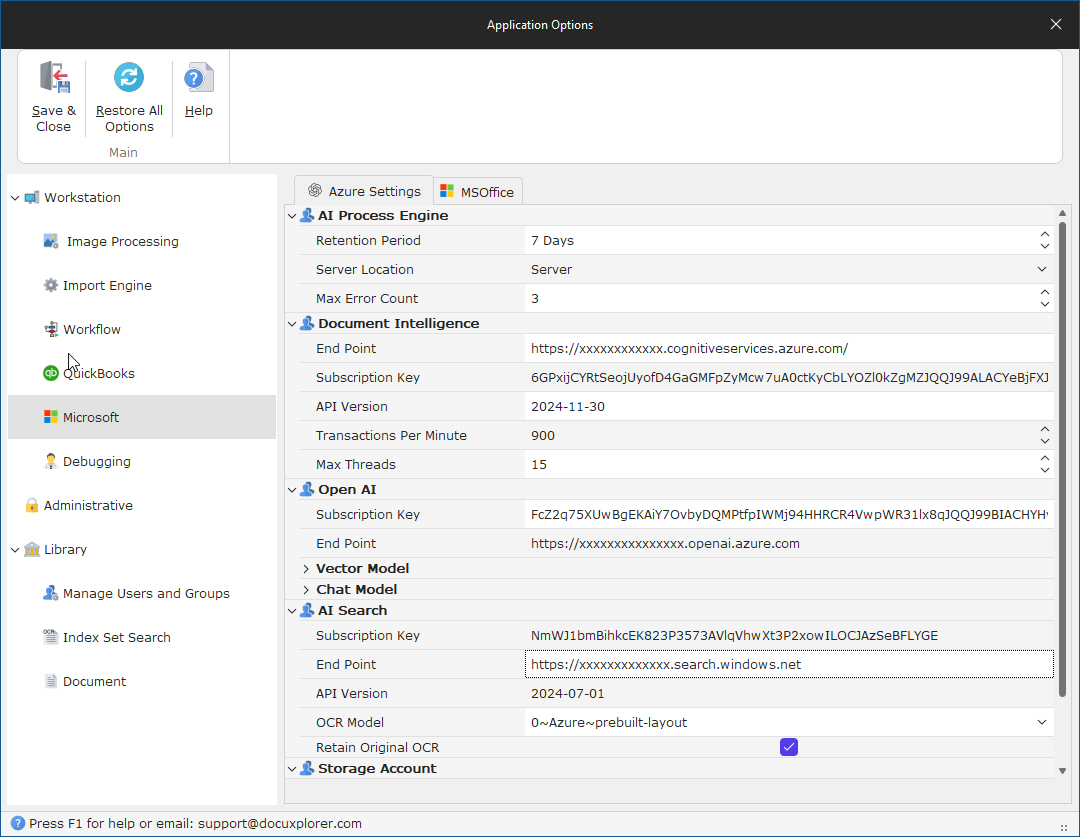
The image above shows the Azure Settings. These settings configure how the software communicates with Microsoft Azure cloud services to perform automated tasks like text extraction (OCR), document classification, and AI-driven searching.
Below is an explanation of each section and setting:
1. AI Process Engine
This section controls the high-level behavior of the automation queue.
Retention Period (7 Days): Determines how long the system keeps a record or "log" of processed documents before clearing them.
Server Location (Server): Indicates where the processing engine is running. "Server" typically means the tasks are handled by a central background service rather than the local user's workstation.
Max
Error Count (3): The number of times the system will attempt
to process a document if it fails before it stops and flags it as
an error.
2. Document Intelligence (formerly Form Recognizer)
This service uses machine learning to identify and extract text and data from forms (invoices, receipts, etc.).
End Point: The specific URL where your Azure service is hosted.
Subscription Key: Your private security key used to authenticate and "bill" your Azure account for the service.
API Version: Specifies which version of the Microsoft code the app is using. This version is a "General Availability" (stable) release.
Transactions Per Minute (900): Limits how fast the app sends documents to Azure to avoid hitting "Rate Limits" on your Azure subscription.
Max
Threads (15): The number of documents the system tries to process
simultaneously.
3. Open AI
This configures the connection to Azure OpenAI, which handles "AI Insights"; conversational queries about your documents.
Subscription Key / End Point: Similar to Document Intelligence, these connect the app to your specific OpenAI resource in the Azure cloud.
Vector
Model / Chat Model: These dropdowns (collapsed in the image)
allow you to choose which specific "brain" to use (e.g.,
text-embedding-3 for searching or gpt-4o for chatting).
4. AI Search
This powers the ability to search inside your documents using advanced AI rather than just keyword matching.
Subscription Key / End Point: Credentials for your Azure AI Search resource.
API Version: The stable version of the search API being used.
OCR Model (0~Azure~prebuilt-layout): This tells the search engine to use Microsoft's "Layout" model, which is excellent at understanding tables, headers, and the visual structure of a page.
Retain Original OCR: When checked, the system will keep any existing text data found in the document rather than overwriting it entirely with the new AI-generated text.
5. Storeage Account
Azure Storage Account Configuration The Storage Account section links the application to your Microsoft Azure storage environment, which serves as the cloud repository for document data and metadata.
Storage Name: The unique identifier for your Azure Storage resource.
End Point: The base URL used to access the storage services.
Access Key:
The encrypted security string required to authenticate the application's
connection to your specific storage container.
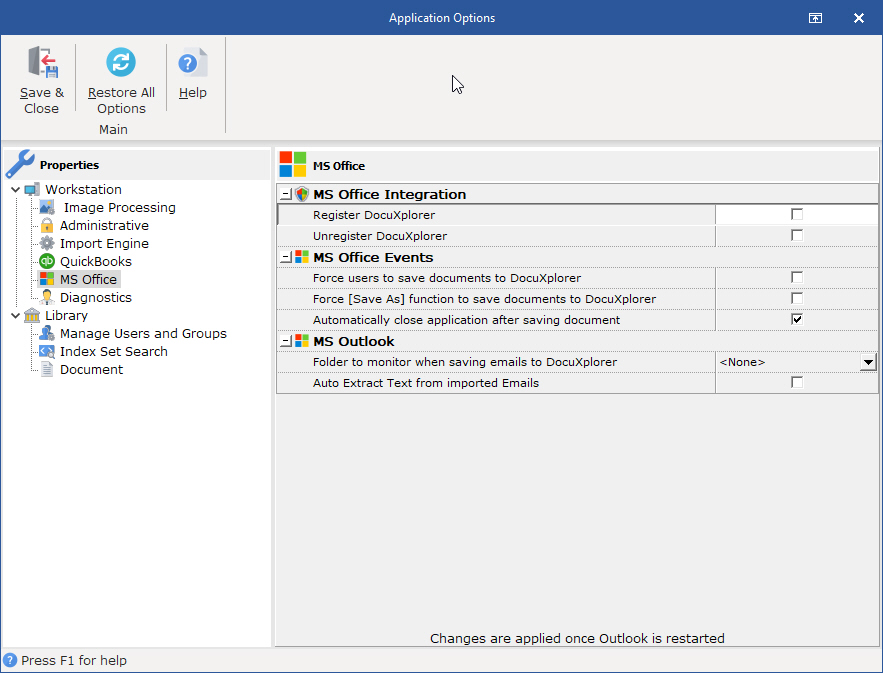
Use this dialog box to install or uninstall the DocuXplorer integration with Microsoft Office programs.
MS Office Integration
Register DocuXplorer - The process of registering places the DocuXplorer Toolbar and other Add-ins into the allowed Microsoft Office programs.
Unregister DocuXplorer - The process of unregistering removes the DocuXplorer Toolbar and other Add-ins from Office programs.
Tip
Users can install and register DocuXplorer as a COM Add-in from within each Microsoft Office program. See the item Installing Microsoft Office Integration for more information.
Close all Office programs when setting or changing DocuXplorer - MS Office defaults.
MS Office Events
Force users to save documents to DocuXplorer
Checking this box will force the <File> <Save> item in Office programs to save documents to DocuXplorer rather than a hard drive as a default.
Force "Save As" function in MS Office to save documents to DocuXplorer
With this box checked users are forced to save documents to DocuXplorer when using the "Save As" function in support MS Office programs.
Automatically close application after saving document
Checking this box will automatically close Office applications after document is saved to DocuXplorer. The exception is Outlook. Even if checked Outlook will remain open when saving e-mail messages and attachments.
When "Automatically close the application after saving document" is checked and there is more than one document open in an MS Office program, the Office program will not close. Only the document being added to DocuXplorer will close.
Outlook
Folder to monitor when saving emails to DocuXplorer
Allows user to select a folder to monitor. When an email is added to that folder DocuXplorer will automatically run and ask the user to select a location to save the email and index it. The body of the email can be automatically added to the description field.
Auto Extract text from imported emails
When in Outlook a user can save the selected email to DocuXplorer. This option now can extract the text of the email and will post it to the OCR text field so emails can be full text searched.